
General Curatorial Text
Picasso: The Making of a Genius presents the celebrated Spanish artist at the centre of a rich network of personal, emotional and professional relationships that shaped both his artistic development and his public image. Figures such as Dora Maar, Françoise Gilot and Robert Capa are given renewed and appropriate space, allowing their independent perspectives to illuminate the broader creative world in which Picasso lived and worked.
Presenting this newly conceived exhibition in Brazil carries particular significance. Picasso’s work formed part of the visual culture of Brazilian modernism, influencing artists such as Tarsila do Amaral, Emiliano Di Cavalcanti and Candido Portinari, and reached a decisive moment of public recognition with the presentation of Guernica at the Second São Paulo Biennial in 1953–1954. The exhibition thus renews a longstanding dialogue between Picasso and Brazilian culture.
The visitor is invited to explore key moments in Picasso’s career and the forces that nourished his imagination: the studio, the human figure, the circus, mythology, the bullfight, ceramics, photography, love and personal relationships. Moving across techniques, styles and media with extraordinary freedom, Picasso transformed every object, body, memory and encounter into a source of invention. Prints, ceramics, photographs and documentary materials reveal the continuous passage from lived experience to new visual forms.
In the exhibition, the exceptional presence of the complete Suite des Saltimbanques—created when Picasso was little more than twenty years old and rarely shown in its entirety—reminds us that printmaking was one of the central laboratories of his artistic thought. From these early works to his later experiments with etching, drypoint, aquatint, lithography and linocut, graphic art offered him a language of constant revision and transformation, while also allowing his images to circulate internationally.
In 1964, speaking of the new “mechanical brains or calculating machines,” Picasso remarked: “But they are useless. They can only give you answers.” In the age of artificial intelligence, his provocation acquires renewed relevance. Answers alone are not enough: we must also know how to ask questions. This is precisely what Picasso’s art continues to do, altering our perception of reality and inviting us to imagine it differently.
Luca Baroni
Pablo Picasso – Biography
Pablo Picasso was born in Málaga, Spain, in 1881. The son of a painter and drawing teacher, he displayed exceptional artistic ability from childhood and trained in Barcelona and Madrid. In 1904 he settled in Paris, then a centre of the European avant-garde, where he entered a dynamic community of artists, writers, poets, dealers and collectors.
His early career developed from the melancholy figures of the Blue Period to the warmer colours and circus performers of the Rose Period. From 1907 onward, working closely with Georges Braque, Picasso played a decisive role in the development of Cubism. Objects and bodies were fragmented into simplified forms and represented from multiple viewpoints, transforming traditional ideas of space and perspective.
Cubism, however, was only one chapter in a career spanning more than seventy years. Picasso moved freely between classical figuration, abstraction, expressive distortion and the reinterpretation of earlier art. He worked as a painter, draughtsman, printmaker, sculptor, ceramicist and designer for the theatre. His recurring subjects included the studio, the human body, love, family life, mythology, bullfighting and war.
In 1937 he created Guernica, his celebrated response to the bombing of the Basque town during the Spanish Civil War. The painting became one of the twentieth century’s most powerful images of civilian suffering and opposition to violence.
Picasso spent the final decades of his life in southern France and continued working with extraordinary intensity until his death in Mougins in 1973. His importance lies not in any single style, but in his ability to question established conventions and transform every material, image and experience into a new field of invention.
Picasso Printmaker
From the beginning of the twentieth century until the final years of his life, printmaking remained one of the principal laboratories of Picasso’s invention. He produced more than 2,000 graphic works—not counting their numerous proofs and successive states—making him one of the most prolific and influential printmakers of the modern era.
Picasso explored etching, drypoint, aquatint, lithography, linocut and other processes, treating each technique as an independent artistic language rather than as a means of reproducing his paintings. The physical demands of printmaking offered possibilities unavailable in other media. He drew into copper, worked with acid and ink, scraped and altered surfaces, reversed images and returned repeatedly to the same matrix.
Successive states allowed him to revise, simplify and transform a composition, preserving the movement of his thought from one solution to another. A face, body, bull or studio was never definitive: each version could generate a new possibility.
His achievements also depended upon close collaboration with highly skilled printers. Roger Lacourière assisted his exploration of intaglio techniques during the 1930s; the Mourlot workshop became central to his lithographic production from the 1940s; and the Crommelynck brothers later supported some of his most technically adventurous etchings. These collaborations joined Picasso’s imagination with specialist knowledge of plates, stones, paper, ink and the press.
Major cycles such as the Suite des Saltimbanques and the Tauromaquia, both presented here in their entirety, demonstrate the range of his graphic language: from rarefied, intimate lines to dense blacks, rapid movement and spectacle.
Because several authentic impressions could be printed from the same matrix, his images entered museums, libraries and collections around the world. Printmaking therefore contributed decisively to the circulation of Picasso’s work and to his emergence as a global cultural icon.
Picasso and Brazil
Picasso has occupied a special place in Brazilian culture for more than a century. His work became known to the country’s modernist artists during the 1920s, when several travelled to Paris and encountered Cubism and the European avant-garde directly.
Among them were Tarsila do Amaral and Emiliano Di Cavalcanti. Born in Capivari, in the state of São Paulo, Tarsila studied in Paris and absorbed the lessons of Cubism without merely imitating them. Di Cavalcanti, one of the organizers of the 1922 Semana de Arte Moderna in São Paulo, likewise looked to Picasso while developing a distinctly Brazilian language centred on urban life, popular culture and the human figure. Together with artists such as Candido Portinari, they transformed international modernism into images rooted in Brazilian society.
The decisive public encounter came with the Second São Paulo Biennial, held from December 1953 to February 1954. Picasso strongly supported the project and wanted his celebrated masterpiece, Guernica, to stand at the centre of the exhibition. The painting still belonged to him, although it was held on long-term loan at the Museum of Modern Art in New York. MoMA expressed concern about its condition and the risks of further travel, but Picasso confirmed the loan.
After an exhibition in Milan, the vast canvas travelled to Brazil and arrived in São Paulo in December 1953. Its presence transformed the event, which is still remembered as the “Guernica Biennial.” It was the only occasion on which the painting was exhibited in Latin America.
Guernica placed Picasso at the centre of Brazilian discussions about modernity, war and the political responsibilities of art. His work remained present through major exhibitions in São Paulo in 2004, São Paulo and Rio de Janeiro in 2015, São Paulo in 2016 and São Paulo again in 2023. Together, these moments reveal a continuing dialogue between Picasso and Brazilian modern and contemporary culture.
Picasso Today: A Global Cultural Icon
Picasso’s influence extends far beyond museums and the history of modern art. His name, face and unmistakable visual language have entered global popular culture. Fragmented profiles, displaced eyes, bold outlines and simplified bodies are immediately described as “Picassoesque,” even by people who may never have encountered one of his works in person.
His legacy can be seen in fashion, graphic design, advertising, photography, cinema and music. Designers, brands and contemporary artists continue to reinterpret his lines, colours and geometric forms, sometimes in homage and sometimes critically. His name has appeared on clothing, posters and consumer products, and even entered the automobile industry through Citroën models such as the Xsara Picasso and C4 Picasso. This unusual association demonstrates how completely Picasso came to represent invention, originality and modern design.
Such fame inevitably contains contradictions. Picasso remains a symbol of artistic freedom and constant reinvention, while his personal relationships, relation with women and carefully constructed public mythology are increasingly reconsidered from contemporary perspectives. His legacy endures precisely because it continues to generate admiration, debate and new interpretations.
The artist’s legal and intellectual heritage is safeguarded by the Succession Picasso and Picasso Administration, established in 1995. They manage the rights associated with his works, name, image and trademarks, authorize their use and, through the Comité Picasso, issue opinions concerning authenticity. Their work also helps distinguish Picasso’s historical and artistic legacy from unauthorized commercial exploitation.
Ceramics
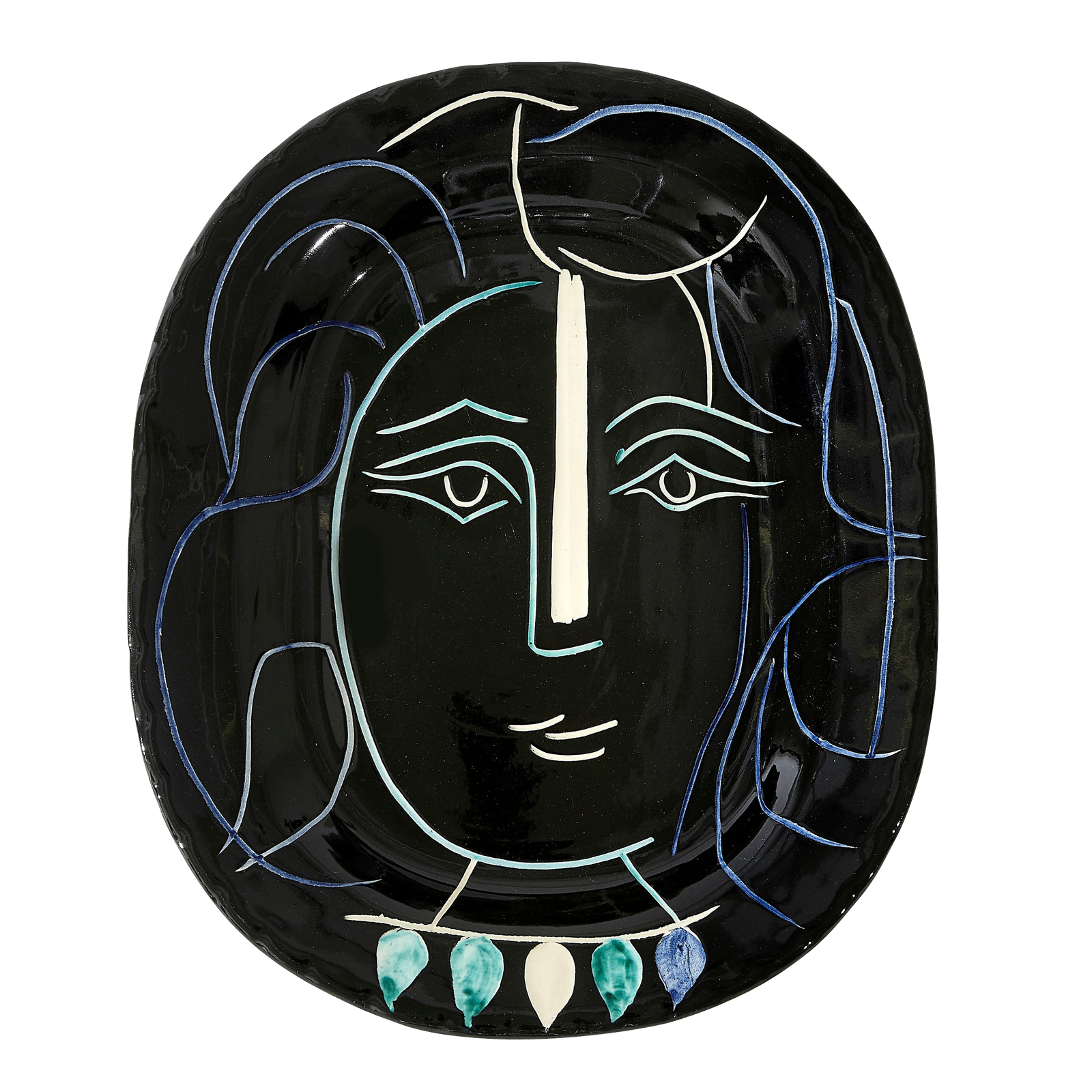
Picasso began working intensively with ceramics in 1947, after encountering Suzanne and Georges Ramié and the Madoura workshop in Vallauris, in southern France. Although he had experimented with clay earlier, it was there that ceramics became a sustained and central part of his artistic practice.
For centuries, ceramics had occupied an ambiguous position between art and craft. It was frequently confined to decoration and the applied arts, despite major traditions in which it had achieved the highest artistic status: from Spanish pottery and the culture of azulejos to the great Italian Renaissance centres of Faenza and Urbino.
Picasso revitalized this heritage without merely imitating it. He approached ceramics as a living Mediterranean language, connected with ancient and popular traditions but open to radical reinvention. Plates, dishes, jugs and vessels became faces, animals and bodies. Their curves, handles and volumes were no longer neutral supports, but active elements of the image: a rim might suggest a face, a handle an arm or beak, and the body of a vessel a human or animal figure.
Ceramics allowed Picasso to unite painting, sculpture, craft and everyday life. Clay, colour and volume became part of a single creative process in which the original function of an object remained visible even as its identity was transformed.
Through this extensive production, Picasso helped restore international attention to ceramics during the twentieth century. He demonstrated that an ancient and familiar material could once again become a major language of modern artistic expression.
Robert Capa
In 1948, the Hungarian-born photographer Robert Capa, one of the leading figures of twentieth-century photojournalism and a co-founder of Magnum Photos, photographed Pablo Picasso and Françoise Gilot on the French Mediterranean coast.
Far from the solemn atmosphere of a museum or formal studio portrait, these images show Picasso walking by the sea, playing with his children and sharing ordinary moments of family life.
Capa was already one of the most celebrated photographers of his generation. His images do more than record the private life of a famous artist: they reveal how Picasso’s everyday existence became inseparable from the construction of his public image. Even the simplest gesture appears suspended between spontaneity and performance.
The celebrated photograph of Picasso carrying a parasol for Gilot is exemplary. At first sight, the scene appears playful and intimate. Yet its composition subtly reverses the roles traditionally assigned to the famous artist and his companion: Picasso follows behind with the parasol, while Gilot walks confidently toward the camera. The image captures their relationship while preserving her presence and independence.
Capa’s photographs contributed decisively to the modern mythology of Picasso. They present him not only as the artist hidden within his atelier, but as a recognizable public figure whose face, gestures, family and private surroundings became part of twentieth-century visual culture.
At the same time, they remind us that photography never merely observes fame: it actively participates in creating it.
Tauromaquia
Picasso’s La Tauromaquia is one of the major graphic cycles of his maturity and is presented here in its entirety. The images were created principally in 1957 and published in Barcelona in 1959 by Editorial Gustavo Gili. The illustrated book combines twenty-six lift-ground aquatints with a drypoint frontispiece and accompanies La Tauromaquia o arte de torear, the celebrated treatise by the eighteenth-century bullfighter José Delgado, known as Pepe Illo.
The bullfight had fascinated Picasso since childhood and remained closely connected with his Spanish and Mediterranean imagination. In this cycle, however, the arena becomes above all a theatre of movement. Bulls, horses, matadors and spectators are rendered through sweeping gestures, rapid silhouettes and dense areas of black.
Lift-ground, or sugar-lift, aquatint allowed Picasso to draw freely with a brush on the copper plate. The resulting marks preserve the immediacy of ink and wash while acquiring the depth and texture of an intaglio print. The technique was therefore ideally suited to his desire to capture the speed, danger and physical energy of the spectacle.
The cycle also establishes a dialogue with Francisco de Goya, one of Picasso’s great Spanish predecessors. Goya’s Tauromaquia, first published in 1816 as a sequence of thirty-three prints, had transformed the bullfight into a modern graphic subject, combining historical narrative, observation, drama and technical experimentation. More than a century later, Picasso returned to the same tradition with a faster, more condensed and intensely physical language.
His suite can be understood both as an homage to Goya and as a modern response to him. Presented together, its twenty-seven sheets acquire the rhythm of a continuous visual narrative: the arena becomes a page, action becomes composition and movement is transformed into line.
Saltimbanques
Created between 1904 and 1906, the fifteen prints known as the Suite des Saltimbanques constitute one of the great achievements of twentieth-century printmaking. In 1913, Picasso’s principal Parisian dealer, Ambroise Vollard, brought the plates together and published them in an edition of 250, printed by Louis Fort. Complete sets are now exceptionally rare and seldom displayed in their entirety.
The series places humble and marginal figures at the centre of the image: acrobats, travelling performers, impoverished couples, mothers and children. Picasso does not present them as picturesque curiosities. Through their silence, fragile gestures and isolation, he gives them dignity and emotional gravity. These figures become the protagonists of a modern meditation on poverty, solitude and human closeness.
The suite demonstrates Picasso’s early mastery of printmaking. He employed etching, in which acid bites the drawn lines into the plate, and drypoint, in which the copper surface is scratched directly with a sharp needle. The raised metal created by drypoint retains ink and produces soft, velvety contours, although it wears down rapidly during printing.
These techniques allowed Picasso to alternate darker passages with images reduced to a few essential lines. Within this extreme economy of means, a single contour or gesture can evoke a body, an atmosphere and an emotion.
At the centre of the series stands The Frugal Repast, created in 1904, when Picasso was twenty-three. Although only his second etching, it already reveals remarkable command of the medium. Two emaciated figures sit before an almost empty table, joined by poverty, intimacy and mutual dependence. It remains one of the most iconic images of Picasso’s career and of twentieth-century art as a whole.
Dora Maar
Dora Maar was born Henriette Theodora Markovitch in Paris in 1907, to a Croatian father and a French mother. She spent much of her childhood between France and Buenos Aires before returning to Paris around 1926 to study art and photography. Long before meeting Picasso, she had established herself as an independent and innovative artist.
The works presented here reveal the breadth of her practice. Four unique works dating from around 1960—Les Pommes de Cézanne, drawn in pen on paper; Composition, an oil on canvas; Pluie, a watercolour; and a further drawing heightened with watercolour—demonstrate that Maar’s creative identity extended well beyond photography.
The exhibition also includes ten photogravure images from Le Temps déborde, published in 1947. This poetic sequence originated in Maar’s collaboration with the writer Paul Éluard and combines photography, memory and loss in a deeply personal meditation on time and absence. A photographic image of Guernica, published in the periodical Verve, recalls another central aspect of her artistic legacy.
Maar worked in fashion and advertising but also created experimental photomontages and socially engaged photographs of poverty and everyday life. Closely associated with Surrealism and politically engaged with the anti-fascist left, she developed a visual language characterized by formal invention, social awareness and psychological intensity.
She met Picasso in Paris during the winter of 1935–1936. Their relationship continued until the early 1940s and was marked by artistic exchange, but also by conflict and an unequal balance of power. Picasso portrayed Maar repeatedly, often as a figure of grief. Those images express his perception of her, but cannot encompass her identity.
Guernica
Guernica was painted in 1937 in response to the bombing of the Basque town of the same name during the Spanish Civil War. Created for the Spanish Pavilion at the International Exhibition in Paris, the enormous black-and-white canvas transformed a specific historical event into a universal image of violence, terror and civilian suffering.
Picasso avoided a literal account of the attack. Instead, he assembled fragmented bodies, a grieving mother, a fallen soldier, a wounded horse and a bull within a compressed and chaotic space. The restricted palette recalls newspaper photographs, while the broken forms and sharp contrasts communicate the shock and confusion of war. Guernica soon became Picasso’s most celebrated masterpiece and one of the twentieth century’s most powerful symbols against violence.
Dora Maar played an essential role in its history. Between 11 May and 4 June 1937, she photographed the painting at different stages in Picasso’s Paris studio. Her images reveal how figures were introduced, removed and transformed as the composition developed.
Guernica also holds a unique place in Brazilian cultural memory. It was presented at the Second São Paulo Biennial, held from 13 December 1953 to 26 February 1954, as the centrepiece of a major Picasso retrospective. Picasso personally supported the loan despite concerns in New York about the risks of moving the vast and already fragile canvas.
This was the only time Guernica was exhibited in Latin America. Its presence made such an impression that the event is still remembered as the “Guernica Biennial.”
Brazilian modernists had already studied and collected Picasso’s work. The arrival of Guernica strengthened this dialogue, renewing debates about modern form, political commitment and art’s ability to respond to contemporary history.
Françoise Gilot
Françoise Gilot was born in Neuilly-sur-Seine, near Paris, in 1921. She studied literature and law while pursuing her artistic training and had already begun exhibiting when she met Picasso in May 1943. Their relationship became established in 1946, and they had two children: Claude, born in 1947, and Paloma, born in 1949.
The works presented here belong to Pages d’amour, a complete group of sixteen lithographs published in 1951. Through a sequence of intimate and lyrical images, Gilot developed a visual language centred on affection, memory, family life and the emotional experience of everyday existence. The series allows visitors to encounter her art directly, rather than seeing her only through Picasso’s portraits or through the history of their relationship.
Gilot was a painter, printmaker, writer and intellectual with a firmly independent artistic identity. During the years she shared with Picasso in Paris and southern France, she continued to work and exhibit, developing her own imagery alongside his. Pages d’amour emerged from this creative environment but should not be understood as an appendix to Picasso’s production. The lithographs possess their own rhythm, sensitivity and graphic coherence.
Their relationship was nevertheless shaped by Picasso’s dominant personality and by an unequal balance of power. In 1953 Gilot left him and returned to Paris with their children. Her decision became a powerful expression of her determination to preserve both her personal freedom and her artistic autonomy.
The presence of Pages d’amour gives Gilot an independent voice within the exhibition. She appears not simply as Picasso’s companion, model or muse, but as an artist whose images offer another perspective on the shared world of creativity, intimacy and human relationships. Her long subsequent career confirmed her place within twentieth-century art in her own right.
Atelier
The studio occupied a central place in Picasso’s imagination. It was not simply the room in which he worked, but a space of continuous transformation, where the artist, the model, everyday objects and personal memories could be combined and reinvented. Bottles, musical instruments, flowers, bodies and animals entered the atelier and emerged as new images.
The works shown here come from Dans l’Atelier de Picasso, a book written by Picasso’s friend and secretary Jaime Sabartés and published in Paris by Fernand Mourlot in 1957, in a limited edition of 275 copies. The volume combined original transfer lithographs by Picasso with refined lithographic and colour reproductions of his drawings, paintings and collages, produced by the celebrated Mourlot workshop under the artist’s supervision.
These images should not be understood as isolated reproductions, but as elements of a carefully conceived publication created through Picasso’s collaboration with Sabartés and the specialist printers of the Mourlot workshop. Produced during the artist’s lifetime and with his direct involvement, they reveal the importance of the network of writers, publishers and craftsmen who interpreted, translated and brought his work to a wider public.
A selection of original etchings from Le Chef-d’œuvre inconnu completes the section. Published in 1931 by Picasso’s principal Parisian dealer, Ambroise Vollard, the book illustrated Honoré de Balzac’s story The Unknown Masterpiece. Its protagonist, the painter Frenhofer, devotes years to pursuing a perfect painting that no one else can understand.
Picasso recognized in Balzac’s story a profound reflection on artistic creation: the relationship between painter and model, vision and execution, inspiration and obsession, achievement and failure. In his delicate etchings, the studio is reduced to a few essential lines, yet becomes an entire world of looking, making and imagining.